Silver Jubilee (train)
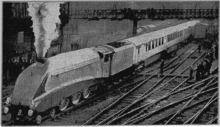 The Silver Jubilee train leaving King's Cross on 27 September 1935 on a trial run north during which it attained a record speed of 112 miles per hour (180 km/h) | |
| Overview | |
|---|---|
| Service type | Passenger train |
| First service | 30 September 1935 |
| Former operator(s) | London and North Eastern Railway British Rail |
| Route | |
| Start | London King's Cross |
| End | Newcastle |
| Service frequency | Daily |
| Line(s) used | East Coast Main Line |
The Silver Jubilee was a named train of the London & North Eastern Railway (LNER).
Contents
1 History
2 Technical details
3 Revival
4 See also
5 References
History
It commenced service on 30 September 1935, the train travelling between London King's Cross and Newcastle. It did this at an average speed of 67 mph (108 km/h), taking four hours to complete the journey.[1] The high average speed was maintained by running at high speeds uphill. [2]
The train was made in the year of King George V's Silver Jubilee, and was painted silver throughout. It was composed of two twin-set articulated coaches, and one triple-set; seven coaches in all.
The train set a new standard for speed in Britain, at that time. Service continued until the outbreak of the Second World War in 1939.[3]
Technical details
Engine and train: total length 462 ft 2 3⁄8 in (140.88 m)
Total weight: 385 long tons (391 t; 431 short tons).[4]
Revival
The name was briefly applied to one train per day between King's Cross and Edinburgh Waverley in 1977 for the Silver Jubilee of Elizabeth II.
See also
- The Coronation
- East Anglian
References
^ "New Train's Fast Run". Hull Daily Mail. England. 30 September 1935. Retrieved 19 September 2017 – via British Newspaper Archive. (Subscription required (help))..mw-parser-output cite.citation{font-style:inherit}.mw-parser-output q{quotes:"""""""'""'"}.mw-parser-output code.cs1-code{color:inherit;background:inherit;border:inherit;padding:inherit}.mw-parser-output .cs1-lock-free a{background:url("//upload.wikimedia.org/wikipedia/commons/thumb/6/65/Lock-green.svg/9px-Lock-green.svg.png")no-repeat;background-position:right .1em center}.mw-parser-output .cs1-lock-limited a,.mw-parser-output .cs1-lock-registration a{background:url("//upload.wikimedia.org/wikipedia/commons/thumb/d/d6/Lock-gray-alt-2.svg/9px-Lock-gray-alt-2.svg.png")no-repeat;background-position:right .1em center}.mw-parser-output .cs1-lock-subscription a{background:url("//upload.wikimedia.org/wikipedia/commons/thumb/a/aa/Lock-red-alt-2.svg/9px-Lock-red-alt-2.svg.png")no-repeat;background-position:right .1em center}.mw-parser-output .cs1-subscription,.mw-parser-output .cs1-registration{color:#555}.mw-parser-output .cs1-subscription span,.mw-parser-output .cs1-registration span{border-bottom:1px dotted;cursor:help}.mw-parser-output .cs1-hidden-error{display:none;font-size:100%}.mw-parser-output .cs1-visible-error{font-size:100%}.mw-parser-output .cs1-subscription,.mw-parser-output .cs1-registration,.mw-parser-output .cs1-format{font-size:95%}.mw-parser-output .cs1-kern-left,.mw-parser-output .cs1-kern-wl-left{padding-left:0.2em}.mw-parser-output .cs1-kern-right,.mw-parser-output .cs1-kern-wl-right{padding-right:0.2em}
^ "LNER "The Silver Jubilee" Train" (PDF). The Engineer. England. 27 September 1935.
^ Silver Jubilee (6 December 1935). Railway Wonders of the World. Amalgamated Press. pp. 1436–1442.
^ L.N.E.R. The Silver Jubilee. The Locomotive Publishing Co.

